

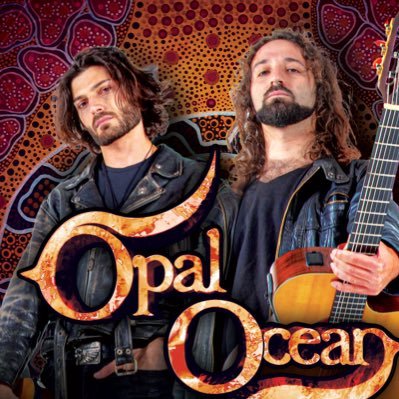
Με αφορμή την πρώτη τους εμφάνιση στην Ελλάδα, οι Opal Ocean έρχονται στην Αθήνα για live στο Piraeus Club Academy, φέρνοντας τον δυναμικό συνδυασμό ροκ, flamenco και progressive, που χαρακτηρίζει τη μουσική τους. Στη συνέντευξη που ακολουθεί μιλούν για την πορεία τους, τη δημιουργία του ήχου τους και όσα να περιμένει το ελληνικό κοινό από τη συναυλία τους.
How did the opportunity arise for Opal Ocean to perform in Greece for the first time?
Alex: Last year we signed with Midnight Mango, a UK-based booking agency, and our booking agent Emilie
started reaching out to see if there were opportunities in other European countries.
She put the feelers out and we ended up getting in touch with Piraeus Club Academy in Greece, who
were interested in bringing us over. That’s essentially how the opportunity came about, and we’re really
excited to finally bring the music there.
What inspired the unique fusion of rock, flamenco, and progressive elements in your sound?
Alex: It’s been a funny journey developing this sound. It actually started out of necessity when I began playing
solo restaurant gigs. I swapped my electric guitar for a classical guitar to create more of an “easy
listening” atmosphere for diners. When I met Nadav, we discovered we had both gone through a similar
phase. Eventually we started to miss the excitement of the heavier music we used to play, so we began
pushing for a more aggressive sound and experimenting with the upper limits of the nylon string guitar.
I’m really pleased with where we’ve taken it. Our latest album Temple Of The Stars is definitely the
furthest we’ve pushed this approach so far.
Nadav: My background is actually quite similar to Alex’s in many ways. I used to do a lot of late-night
busking playing rock and heavy metal on electric guitar. But eventually the local council changed the
rules and I ended up busking during the day outside supermarkets.
At that point I realized that maybe playing Van Halen at 11 a.m. to people doing their grocery shopping
wasn’t the best idea. So I picked up an acoustic guitar and started experimenting with different styles.
The Spanish-style pieces were by far the most popular. From there I started doing restaurant gigs playing
background Spanish music, and eventually I returned to busking where Alex and I met.
That’s when we realized we could fuse our influences together, kind of like what Rodrigo y Gabriela were
doing but with our own mix of rock, flamenco, and progressive elements. That fusion is really how the
Opal Ocean sound was born.
Opal Ocean was formed eleven years ago. How has the band evolved musically and creatively since then?
Alex: Our writing process hasn’t changed dramatically, but we’ve definitely streamlined how we make records.
Our latest album was engineered by ourselves and we kept most of the production in house.
We used to spend thousands of dollars on recording studios. Now we can record and edit at home and
take the time we need to get the right performances. That shift has probably been the biggest change for us.
Nadav: Our songwriting has definitely evolved the most.
Technically we’ve obviously improved as players over the years, that’s inevitable when you spend so
much time playing together. But the songwriting development is what’s been most fascinating.
If you listen back to our first EP or even our first album, the songs were quite simple. The album itself
was a bit of everything (eclectic) , some ideas worked well, some were experiments that didn’t fully land.
But that’s also what makes those recordings special. They capture exactly where we were at that time.
When you listen to our newest material now, it feels much more refined. The songwriting is tighter,
there’s less fluff, and everything feels more intentional. It’s music we genuinely enjoy listening to
ourselves, and it represents the sound we now recognize as Opal Ocean.

Your music is entirely instrumental. How do you create such a powerful connection with the audience
without vocals?
Alex: Honesty, my approach is to strip away appearances and play as close to my core as possible and play as
honestly as possible. Nadav and I have a very special connection, and part of the show is opening that
connection up to include the audience. I often compare instrumental music to abstract painting. With abstract art, the viewer has to imagine the meaning of the piece, whereas in figurative art a picture of a horse is clearly just a horse. Instrumental music works in a similar way, the listener can create their own interpretation and emotional journey.
I think that freedom is part of what helps us connect with people.
Nadav: When we write instrumental music, we always try to keep melody at the center, almost as if there were a
singer. For us, the key is writing melodies that people can remember. There’s nothing worse than listening to a
long instrumental set and not being able to recall a single riff or theme afterwards.
So we try to structure songs with memorable melodic ideas, almost like choruses or vocal lines even
though they’re played on the guitar. If people leave the show humming a melody, then we know we’ve
succeeded.
Which of your songs best represents the essence of your musical style?
Alex: That’s a difficult one because our writing style is quite broad. Our music includes orchestral elements, synths, electric guitars, metal riffs, and even touches of electronic music, all played with what is essentially a Spanish rumba technique. That’s probably why we write albums instead of trying to squeeze everything into one song. Mexicana is a good place for people to start, then maybe Mr Stoker. After that there’s a lot of variety, ballads, high energy tracks, progressive songs with unusual time signatures, and straight up bangers. If I could write one track that summed up everything we do, I would! Personally though, my favourite to play is The Hadal Zone. It’s a bit of a tribute to Tool and it always gets me going.
Nadav: That’s actually a difficult question because each song really is its own journey. Our music pulls from so many influences, from flamenco rumba techniques to electronic and progressive elements that’s why it’s hard to choose just one song that defines everything. That said, “Soul Wanderer” from the new album is a great example of how far we can push the concept. It blends different musical traditions and shows how we like to experiment not just with genres, but also with cultural influences. At the core of Opal Ocean, it’s really about pushing the boundaries of what’s possible with two guitars.
What are the biggest challenges when touring and performing in different countries around the world?
Alex: The financial side is definitely the hardest. We’re still a relatively small act and can’t rely on selling out rooms every night. At the same time, travel costs have skyrocketed in recent years. The main reason we’ve been able to keep touring is because we’ve found ways to minimise our expenses. We do a lot of things ourselves: recording, producing merchandise, designing album artwork, T-shirts and posters, running our website, managing ads, self-managing… even handling the taxes. When you think about it, the actual playing is only a small part of everything that goes on behind the scenes. There are still many countries we’d love to visit, but we have to be patient and keep working our way there. I’m especially excited about our Athens show because it will be our very first performance in Greece.
Nadav: The biggest challenge is often financial uncertainty. Touring is always a bit of a gamble, especially when ticket sales are involved. As an independent band that manages a lot of things ourselves, we sometimes have to take risks and hope everything comes together. Another interesting challenge is adapting to different audiences. When you perform in a country for the first time, you don’t really know how the crowd will react. For example, in some parts of Eastern Europe the audience can be a bit more reserved during the show. They might really enjoy the music, but they express it differently than audiences who jump, dance, and cheer constantly. When you’re used to very energetic crowds, a quieter audience can initially throw you off. But over time you learn that appreciation can be expressed in many different ways.
What can Greek fans expect from your live show at Piraeus Club Academy?
Alex: The beauty of live concerts is that there’s always an element of unpredictability. No one really knows what’s going to happen, and I think that’s one of the reasons people still love going to shows instead of just listening to the album. What I can promise Greek fans is a lot of energy, some playful banter, and plenty of quirky guitar playing. We’re planning to include a few new tracks along with some of our classics.
Nadav: The main thing they can expect is something they probably haven’t quite seen before. What we do is a unique fusion of different genres, and we try to take the audience on a musical journey throughout the show. We also like to keep things fun on stage. There’s usually quite a bit of banter between songs and we don’t take ourselves too seriously… We can be a bit goofy at times. But overall the goal is to create an immersive guitar experience. You can either sit back and get lost in the music or jump around and move to the rhythms. Either way, we’re really looking forward to sharing it with the Greek audience.
Mary Zarakoviti


0 Comments